Working with Law Enforcement
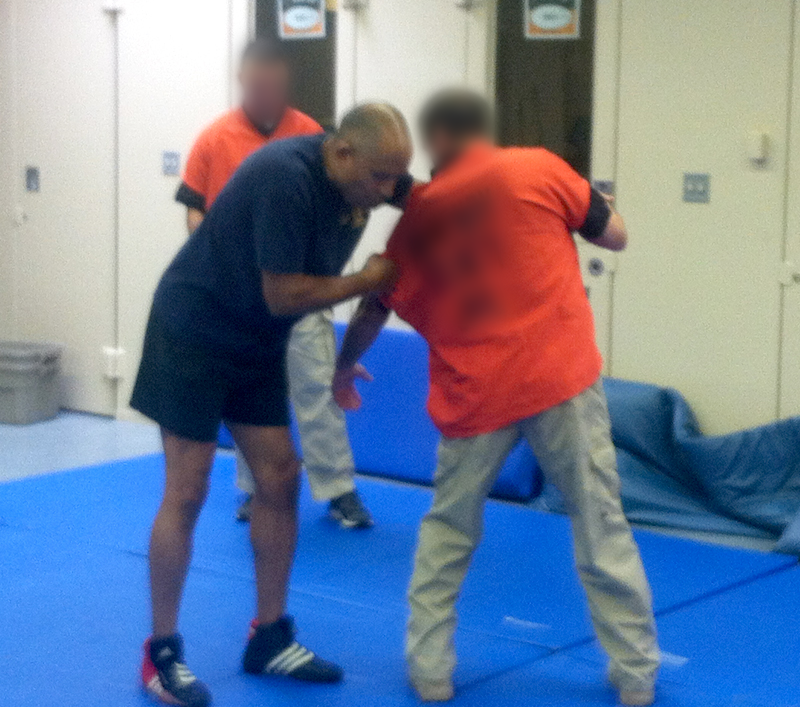
Here I am teaching deputies how to use an inmate's clothing to off-balance
In this article, I'd like to share a glimpse of how I work with law enforcement personnel. I do so from two perspectives:
- Individual officers/deputies/agents
- Groups of officers/deputies/agents
Individual Officers/Deputies/Agents
When an individual officer/deputy/agent approaches me and asks for help with something, I provide practical and personalized instruction on how best to reach their goal. Let me give you an example.
A deputy came to me and asked for help getting suspects to the ground more efficiently. So, I asked him, “Are you more interested in learning new techniques, refining your current ones, or developing a skill—something that gives you greater confidence by the end of your lesson?” He replied, “Skill development.” So, that's what we focused on.
First, I asked him to show me what he was currently doing. By watching and feeling what he was doing, I could better understand where he was encountering problems.
The problems involved the deployment of his technique, how he positioned himself for the control and takedown, and a couple of tactical considerations.
Second, I gave him some new ideas on how to properly position himself before deploying the bar-arm takedown (so he would stop getting punched in the face), some improved mechanics for the technique he was already using, and a couple of tactical considerations to prevent the two most common forms of resistance.
Third, I had him put on a pair of boxing gloves and try to punch me HARD while resisting the takedown. He was impressed that (A) he couldn't hit me, (B) he couldn't resist the takedown, and (C) even after a handful of repetitions, he didn't get hurt.
Fourth, I had him practice the new material on me—first the technical aspects, then the positional, then the tactical, and finally with me wearing the boxing gloves.
Fifth, I gave him some ideas on how best to practice because mimicking an instructor's movements is an old, archaic method that primarily helps officers/deputies/agents REMEMBER what they were taught. In other words, it rarely helps them develop skill or confidence.
By the end of the lesson, the deputy not only had new information to work on (because I gave him a prescribed timeline for practice and measurement), but he also had increased awareness, confidence, and skill.
Groups of Officers/Deputies/Agents
When someone asks me to teach their officers/deputies/agents, I ask what they'd like me to focus on—technical knowledge and refinement, or specific skill development. Whatever they tell me, I go from there. Let me give you an example.
A sergeant asked me to work with his officers on dealing with surprise attacks involving edged weapons. I asked him what their current training covered, and he said, “Our current training only deals with subjects who brandish a weapon at a distance. We don't have any training on surprise assaults with edged weapons.”
So, I agreed to work with the sergeant and his officers.
First, I taught them some “imperative” fundamentals. These fundamentals were more important than the techniques I would eventually teach them.
Second, I taught them two primary techniques and one secondary technique.
Third, I taught them how to practice these techniques in a way that would genuinely surprise the officers. NOTE: Adding the element of surprise can be challenging in a group training environment, but it is possible!
Fourth, I taught them how to keep their training safe and productive. This is important because all too often when officers add “realism” to the training, someone gets hurt—and this is sometimes problematic.
After the training had ended and everyone had let their guard down, they were given A BIG SURPRISE—something they never saw coming!
If you or your agency would be interested in working with me, email me at the address below, and let's chat.
Thank you for your time,
Roy
Phone: 1-98-98-HARRIS
Email: roy@royharris.com